
Reviewed · HISTORICAL TOURS
Historical Beirut Tour (AM) Half Day – (4G on Board)
Beirut’s story is unusually easy to read in a single morning. Roman baths sit near rebuilt downtown streets, Ottoman-era conflict shapes Martyr’s Square, and the National Museum gathers thousands of years of Lebanon under one roof. I like that this tour connects those pieces instead of treating Beirut as a collection of unrelated sights.
I especially like the National Museum visit, which gives the city’s scattered ruins a clear timeline, and the guides’ personal historical commentary. Madeleine and Eliane are singled out for thoughtful, engaging explanations, particularly about the civil war and the rebuilding of downtown. The main drawback is simple: this is not a full walking tour. Several stops are brief, and about an hour is spent inside the museum.
At a glance
- Five-thousand-year story in three hours: Hear how Beirut grew from an ancient settlement into a Roman city-state and later became modern Lebanon’s capital.
- The National Museum is the centerpiece: Allow an hour for Phoenician statues, Byzantine mosaics, and Roman artifacts.
- Downtown stops are concise: Martyr’s Square, Nejmeh Square, the Roman baths, and central Beirut are covered, but not at great length.
- Hotel pickup has limits: Pickup and drop-off apply to eligible hotels within Beirut, not hostels, Airbnbs, or private apartments.
- A small-group format: The maximum group size is 25 people, with an air-conditioned vehicle and WiFi on board.
- Best for a first morning: This works well when you want historical bearings before exploring Beirut on your own.
Beirut’s long story begins before the modern city
The tour opens with a short historical introduction, either after pickup from a qualifying central Beirut hotel or at Nakhal Tourism and Travel in downtown Beirut. The start time is 8:30 a.m., so you get an early look at the city before the day grows warmer and busier.
Your guide places Beirut in a much longer story than its modern streets suggest. The settlement dates back more than 5,000 years, and the city later prospered as a Roman city-state from 15 BC. You will also hear about the collapse of the Ottoman Empire after World War I, the creation of modern Lebanon, and Beirut’s ability to retain a liberal character through long periods of destruction.
That introduction matters because Beirut can feel visually fragmented. A restored square, a damaged building, a Roman column, and a modern commercial street may sit within a short distance of one another. Without context, the city’s layers can seem disconnected. A good guide gives those layers names and causes.
The historical tone is not limited to ancient archaeology. Guides such as Eliane have been praised for explaining contested parts of Beirut and the rebuilding of the downtown district after the civil war. That is a useful strength, since the city’s recent past is just as important as its Roman and Phoenician periods.
A few more Beirut trips to weigh up
- PRIVATE Beirut Historical Walking Half Day Tour
★ 5.0 · 27 reviews - Temple of Eshmun – Mleeta Landmark – Beaufort Castle
★ 5.0 · 9 reviews - Guided Half-Day Private Beirut Historical Tour
★ 5.0 · 6 reviews
Martyr’s Square and the memory of Ottoman rule
The first listed stop is Place des Martyrs, also called Martyr’s Square. The visit lasts about 10 minutes and is free, so think of it as a focused introduction rather than an extended exploration.
The square’s central monument honors Lebanese nationalists executed by the Ottomans during World War I. Your guide explains the people and events behind the statue, helping you see it as more than a photo stop. The monument also offers a direct link between Beirut’s political history and its public spaces.
You should keep your expectations realistic here. Ten minutes is enough to view the statue, take photographs, and hear the basic story, but not enough for a detailed study of the surrounding district. If you want to examine the square, nearby buildings, or the city’s recent scars at length, make a note of places to revisit after the tour.
This is one reason the tour works best as an introduction. It points out the key sites and supplies the background, then leaves you better prepared to return independently. The walking portion is not extensive, but it gives you a useful first orientation to central Beirut.
Nejmeh Square and the rebuilt downtown
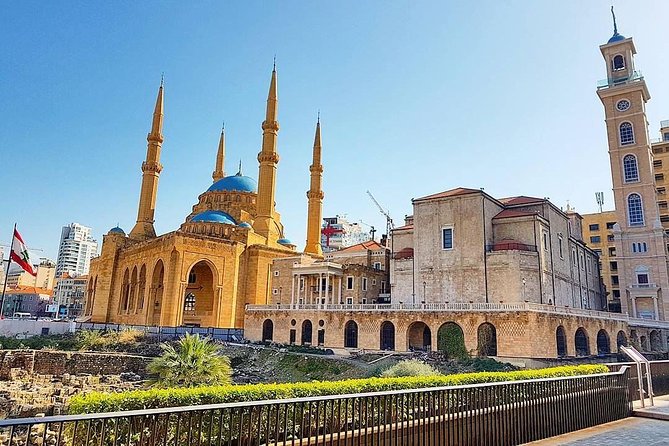
Nejmeh Square is described as the heart of modern Beirut’s downtown. It is known for its central clock tower, built during World War I, and its recently renovated public setting. The square shows how Beirut’s civic center has been repaired and reshaped over time.
I like this stop because it brings several periods together in one compact view. The clock tower recalls the Ottoman era and World War I, while the renewed square reflects the city’s more recent effort to rebuild its center. Your guide’s commentary helps explain the choices and conflicts behind that rebirth.
The tour does not promise entry into every important building. One group happened to gain access to the Parliament area, but that should be treated as a fortunate possibility, not a guaranteed feature. The program focuses on outdoor landmarks, public squares, and historical explanation.
Several people found the downtown portion well paced and informative, while others wanted more time outdoors. That difference comes down to what you want from the morning. If your goal is a quick historical framework followed by a major museum, the timing makes sense. If you want a long architectural walk through central Beirut, this program may feel too compressed.
Roman baths beneath the modern streets
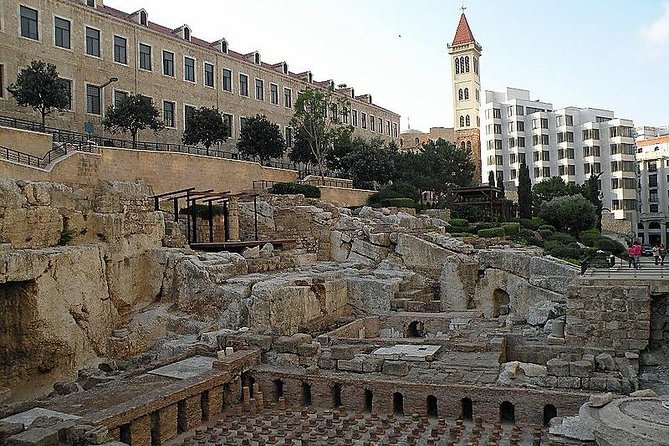
The Roman Bath stop lasts about 30 minutes and is free of charge. Along with downtown Beirut, it gives you a direct look at the ancient city beneath the modern capital.
The baths are particularly useful because they make the Roman period physical. The opening talk about Beirut as a Roman city-state becomes easier to understand when you are looking at surviving archaeological remains rather than only hearing dates. The guide also points out how newer discoveries, including archaeological finds uncovered as recently as 2007, continue to add to Beirut’s story.
This is another stop where the guide makes a major difference. Ruins can look modest if you do not know what you are seeing. A licensed local guide can explain their purpose, age, and connection to the wider city.
Still, the itinerary allows only about half an hour for the Roman baths and downtown together. You will get the essential explanation and time for photographs, but you should not expect an extended archaeological tour. Anyone especially interested in Roman Beirut may want to return later with more time.
Same mountains and coast, a completely different kind of day:
- Guided Small-Group Tour to Baalbek, Anjar and Ksara with Lunch
★ 5.0 · 511 reviews - Guided Small-Group Tour to Jeita, Harissa, Byblos with Lunch
★ 5.0 · 361 reviews - Paragliding Trip Over Lebanon – Jounieh Bay
★ 5.0 · 257 reviews - Jeita Grotto,Harissa&Byblos Full-Day PRIVATE-CAR Trip from Beirut
★ 5.0 · 222 reviews
One hour inside the National Museum of Beirut
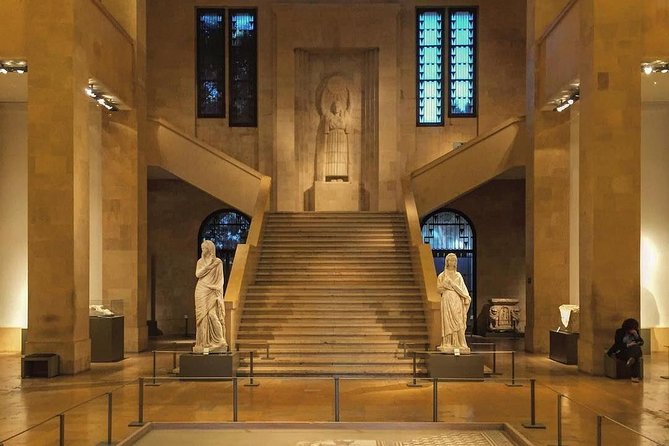
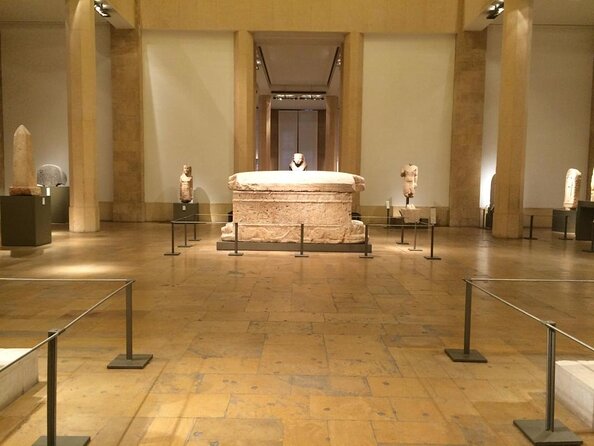
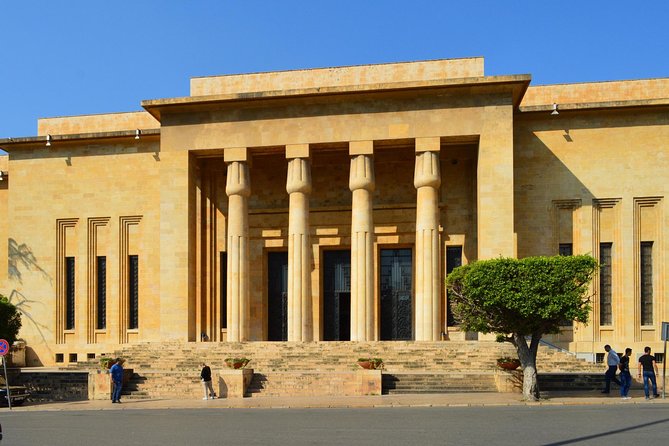
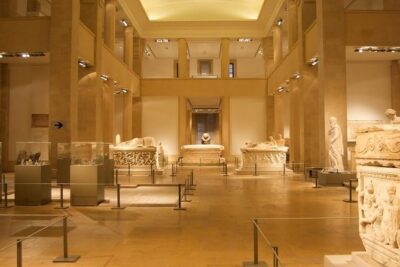
The National Museum is the strongest part of the experience for most history-minded visitors. About one hour is set aside for the museum, and admission is included.
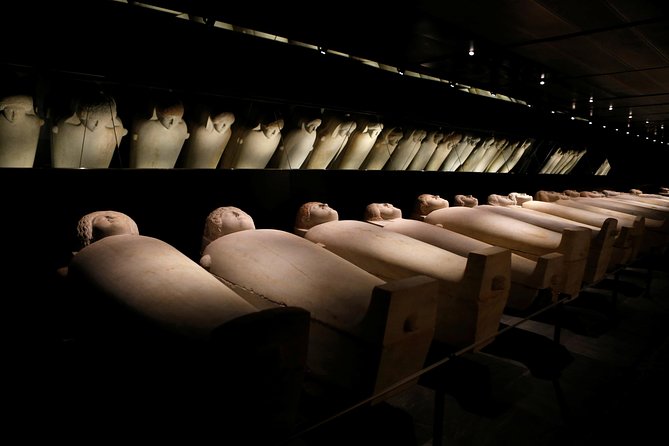
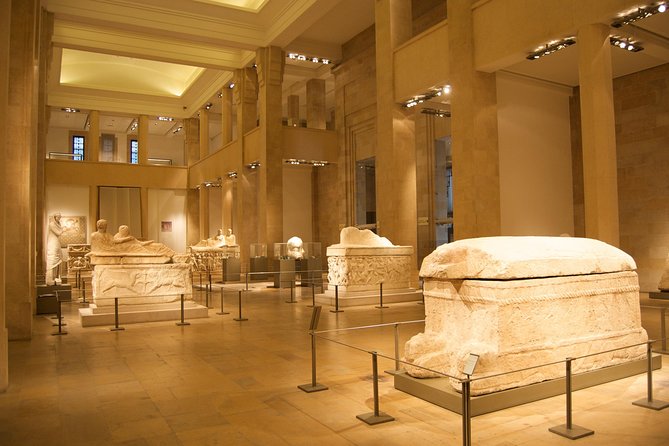
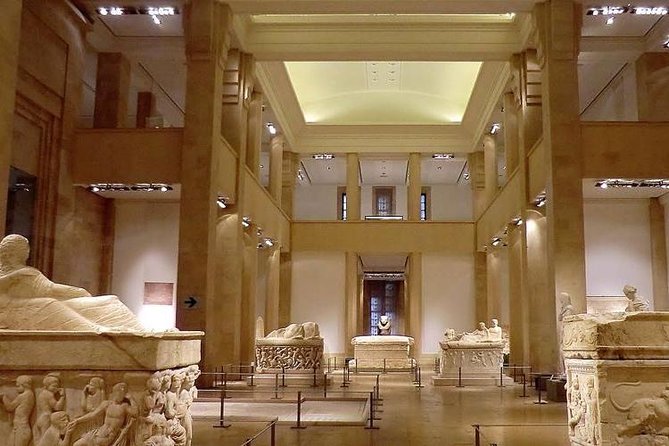
The collection gives you a broad view of Lebanon’s past through objects from several major periods. Look for Phoenician statues, Byzantine mosaics, and Roman pieces. Together, they show Lebanon as a meeting point of cultures rather than a place defined by one era.
The museum also helps explain why Beirut’s past matters beyond the city center. Objects from across Lebanon place the capital within the country’s wider archaeological story. You can move from early civilizations to classical periods and later eras without needing to piece the chronology together from separate sites.
A particularly meaningful part of the visit is the museum’s survival and restoration. The building and collections endured Lebanon’s civil war, and the museum has worked to recover and present its archaeological treasures. The experience includes a video about the museum’s history, according to one account of the tour, which adds useful background to the displays.
The one-hour limit is both a strength and a weakness. It is long enough to see the main highlights without turning a half-day outing into a museum marathon. It is not long enough for a careful look at every gallery or artifact. If you like to read every label, you may want to return on another visit.
Some people would prefer a longer outdoor walk and less museum time. I understand that view, especially in a city where neighborhoods and damaged buildings carry so much recent history. But if you are visiting Beirut for the first time, I would keep the museum. It provides the clearest single overview of Lebanon’s ancient past.
What the guide adds to the experience
The official language options are English and French, and the guide is a licensed local professional. The strongest praise is aimed at the commentary rather than the amount of walking. Madeleine is described as an exceptional guide during the downtown and museum visits, while Eliane is noted for her charm and careful explanations of civil war history and the rebuilding of Beirut.
That kind of local perspective is valuable in Beirut. Dates and monuments are easy enough to find in a guidebook. It is harder to understand why a square matters, how a city center was contested, or how Beirut’s open social character survived repeated upheaval.
The quality of any group tour depends on the guide assigned that morning, so you should not book solely expecting one named guide. Still, the repeated praise for the guide service suggests that historical explanation is a central strength of the program.
The group can include up to 25 people. That is not an intimate private tour, but it remains manageable for a three-hour route. If the group reaches its maximum, staying close to the guide will matter during outdoor stops and city transfers.
Transport, pickup, and what the $50 price covers
At $50 per person, the tour offers reasonable value if you want transport, a guide, and the museum arranged together. The price includes an air-conditioned vehicle, bottled water, WiFi on board, entrance fees, and hotel pickup and drop-off when you stay at an eligible hotel within Beirut City.
That package is more useful than it may first appear. You do not need to arrange a separate ride to the museum or pay museum admission on the spot. Air conditioning is also welcome during a warm Beirut morning, particularly since the program combines short outdoor visits with vehicle transfers.
Pickup is not universal. It applies to hotels within Beirut City, and it does not include hostels, Airbnbs, or private apartments. If you are staying outside the eligible hotel network, the meeting point is Nakhal Tourism and Travel in Beirut. One person found the meeting arrangement inconvenient and had to leave the hotel early to reach the departure point, so confirm your exact pickup details before the morning of the tour.
Lunch is not included. The experience ends back at the original meeting point, giving you the option to arrange your own meal or continue exploring downtown.
Free cancellation is available when you cancel at least 24 hours before the 8:30 a.m. start time. Changes or cancellations made within 24 hours are not accepted for a refund.
The safety question you should consider before booking
The supplied tour information notes a US Department of State warning against travel to Lebanon because of safety and security concerns. It also states that the local provider reports tours operating without disruption and that customers will be notified if conditions change.
That information deserves careful attention. Beirut’s situation can change, and a tour operating as scheduled does not remove the need to check your own government’s current advice, travel insurance conditions, and hotel guidance before booking. If you are already in Lebanon, ask locally about the day’s route and any areas to avoid.
This is a city tour concentrated on central Beirut and the National Museum. It does not include south Beirut, and one informed assessment noted that this politically important part of the city is often left out of standard programs. That omission may matter to you if your main interest is present-day politics or a wider look at Beirut’s neighborhoods.
Who will get the most from this morning
I would choose this tour if you have limited time in Beirut, want a clear historical introduction, or prefer having a local guide explain sensitive and complicated subjects. It is also a good first activity before exploring the city independently.
The program suits you especially well if you enjoy museums and want to see major downtown landmarks without planning transport yourself. The included entrance fee, bottled water, vehicle, and guide make the $50 cost easier to justify.
You may want something else if you are seeking a long walking tour. The outdoor segments are brief, with only about 10 minutes at Martyr’s Square and roughly 30 minutes for the Roman baths and downtown. Several people felt that the museum took too much of the three-hour schedule.
You should also avoid expecting a full survey of Beirut. Ottoman Beirut, entry into key buildings, neighborhood life, and south Beirut are not central parts of this program. Think of it as a compact historical sampler, not a complete portrait of the capital.
Should you book the Historical Beirut Tour?
Book it if you want the National Museum paired with a short, guided introduction to downtown Beirut. The museum is the main reason to go, while the guide’s explanations give meaning to Martyr’s Square, Nejmeh Square, Roman baths, and the city’s difficult modern past.
Skip it if your priority is walking every street, spending more time outdoors, or exploring neighborhoods beyond the central route. In that case, use the tour as a starting point and plan extra independent time afterward.
For most first-time visitors with only one morning, I see this as a useful orientation rather than a complete Beirut experience. It offers strong historical framing, solid practical inclusions, and guides who can make a complicated city easier to understand. Just confirm pickup, check current safety advice, and keep your expectations focused on the museum and a concise downtown introduction.
FAQ
How long does the Historical Beirut Tour last?
The tour lasts approximately three hours and begins at 8:30 a.m. It ends back at the original meeting point.
What places are visited?
The program includes Martyr’s Square, the National Museum of Beirut, the Roman baths, and downtown Beirut, including Nejmeh Square.
Is hotel pickup included?
Pickup and drop-off are included for guests staying at eligible hotels within Beirut City. Pickup is not provided for hostels, Airbnbs, or private apartments.
What is included in the $50 price?
The price includes an air-conditioned vehicle, a licensed English- or French-speaking guide, entrance fees to the listed sites, bottled water, and WiFi on board. Lunch is not included.
How large is the group?
The tour has a maximum of 25 participants.
Can I cancel for a full refund?
Yes. You can cancel for a full refund at least 24 hours before the experience begins. Cancellations or changes made less than 24 hours before the start time are not accepted for a refund.
Just added around Beirut
- Journey Through Time: Half-Day Private Tour to Baalbek★ 5.0 · 3 reviews
- Small Group Tours to Jeita Grotto and Byblos with tickets★ 5.0 · 3 reviews
- Wine Tasting and Culture★ 5.0 · 3 reviews
- Small-Group Tour with Lunch to Jeita Grotto, Byblos and Harissa★ 4.5 · 3 reviews
- Traveling Spoon Lebanese Mezze Private Online Cooking Class★ 5.0 · 4 reviews
- Beirut to Qadisha Valley, Bcharri & Cedar: Daily Tours with Lunch★ 4.5 · 3 reviews
- Small-Group Tour to Sidon, Tyre and Maghdouche with Lunch and Tickets★ 4.5 · 3 reviews
- Small-Group Tour with Lunch to Baalbek, Anjar and Ksara★ 5.0 · 3 reviews
Historical Tours, compared.
Temple of Eshmun – Mleeta Landmark – Beaufort Castle
Read our review →
Sidon & Tyre Unesco Heritage w/pick-up, guide, entries+lunch
Read our review →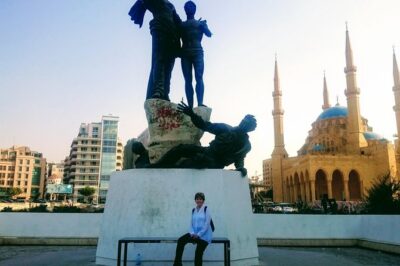
PRIVATE tour to Beirut history museum, Beiteddine & Deir elQamar
Read our review →
Baalbek, Anjar & Wine: A Journey Through Lebanon’s Heritage
Read our review →
Exploring Beirut’s Past: A Private Guided Historical Tour
Read our review →Browse the lists this tour appears in