
Reviewed · SIDON AND TYRE TOURS
Lebanon Unveiled: Exclusive Private Tours to Sidon & Tyre
Sidon and Tyre give you two very different views of southern Lebanon: Sidon feels like a working port city threaded with old souks, while Tyre opens into wide Roman ruins and a seaside town. This private day trip links both with door-to-door transport, so you can leave the road to an experienced driver.
I especially like the contrast between the traditional olive-oil soap workshop in Sidon and Tyre’s huge Roman hippodrome. I also like the small stop at Maghdoucheh, where the shrine of Our Lady of Mantara adds a personal religious story to a day otherwise centered on ancient cities.
The main consideration is time. Nine hours sounds generous, but the route from Beirut, the sightseeing stops, and the return drive make this a full day. Museum and archaeological-site admission fees, as well as lunch, are extra.
Key points to know before you book
- Sidon mixes Crusader ruins, a living souk, and a 17th-century soap factory: You get more than a quick fortress photo.
- Tyre’s Al-Bass site is the archaeological high point: Its Roman road, triumphal arch, aqueduct, sarcophagi, and hippodrome cover a large area.
- Private transport makes the long southern route easier: Hotel pickup and drop-off remove the need to manage Lebanese roads yourself.
- The guiding can add real depth: Hassan has worked as an archaeologist, while Georgette has been praised for her clear and friendly explanations.
- Maghdoucheh changes the pace: The hilltop shrine and cave offer a quiet religious stop between the two ancient cities.
- The $75 price is strongest for small groups: You receive private transportation and a full-day route, but lunch and several entrance tickets are not included.
Why this southern Lebanon day trip works
This is not a sit-back-and-watch-the-country tour with every minute scripted. It is closer to a private driver and sightseeing arrangement, with a tour leader and a local guide in Tyre included. That distinction matters.
You get a vehicle, a driver, hotel pickup and drop-off, and a route that would be awkward to manage independently. At the major stops, you have room to look around rather than being pushed through a large group. The experience is best for you if you value independence but do not want to handle a long day on Lebanese roads.
The route also has a useful rhythm. Sidon supplies the urban life: port views, narrow lanes, craft shops, and an old trading inn. Maghdoucheh provides a short, peaceful pause. Tyre then shifts the focus to large-scale Roman remains and an old market.
Guiding quality may depend on the person assigned to your group. Hassan is described as an archaeologist who brings enthusiasm and strong knowledge of both ancient and recent history. Georgette has also been praised for making the stops interesting and explaining them clearly. If your guide is similarly strong, the ruins become much easier to read.
More Sidon and Tyre tours in Beirut:
- Small-Group Adventure Tour to Sidon Tyre & Maghdouche-Day Trip
★ 5.0 · 45 reviews - Sidon, Tyre & Maghdouche Day Trip – With Lunch (4G on Board)
★ 4.5 · 44 reviews - Guided Small-Group Tour to Sidon, Tyre & Maghdouche with Lunch
★ 5.0 · 41 reviews
Sidon, a Phoenician city with a working pulse
Sidon, also called Saida, is one of the oldest Phoenician cities. Its foundations reach back to the 3rd millennium BC, and it prospered in the 2nd millennium BC through trade, glassware, and the famous purple dye associated with Phoenician ports.
The city’s story did not stop in antiquity. Jesus is said to have visited Sidon, and the city later changed hands several times during the Crusades. Destruction and rebuilding left a town where older layers sit close to daily commerce.
You begin with roughly an hour in Sidon itself, followed by more focused stops. That first period gives you a chance to understand the setting before moving through the castle, khan, museum, and souk.
Do not expect an untouched ancient city. Sidon is a living place, and that is part of its appeal. The old center is not simply a display for visitors. Shops, food sellers, craftsmen, and residents continue to use its lanes.
The Crusaders Sea Castle and Sidon’s harbor
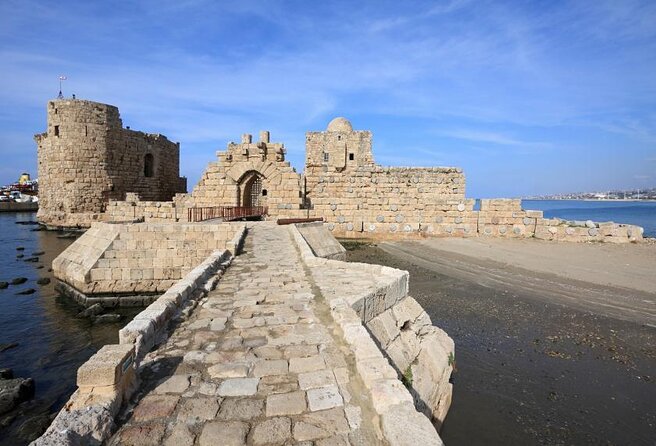
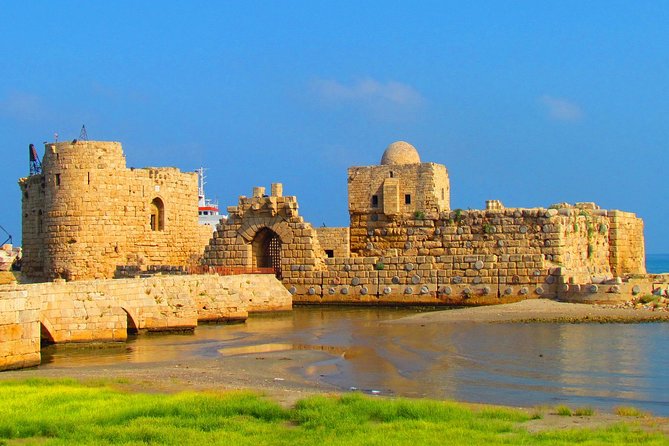
The Sea Castle sits on a small island just off Sidon’s port, linked to the mainland by a stone causeway. Crusaders built it in the 13th century as a fortress connected with the Holy Land. The Mamluks largely destroyed it in 1291, and Fakhr el-Dine Maan II later restored parts of it in the early 17th century.
You have about 30 minutes here. That is enough to explore the remaining walls, look back toward the waterfront, and take in the unusual position above the harbor. The castle is not intact, so this is not a polished fortress visit with rooms full of furnishings. Its appeal is the setting and the sense of military control over the port.
Old prints show a more decorative fortress than the one you see today. Keep that in mind as you walk through the remains. You are looking at a damaged and partly restored structure, not a complete Crusader castle.
Admission is not included, so allow for a separate ticket. Since the stop is short, the castle works best as part of the wider Sidon visit rather than as the sole reason to come here.
Khan al-Franj and the old trade routes
Khan al-Franj takes you from military history to commerce and diplomacy. Emir Fakhreddine II built this 17th-century khan as a hotel for ambassadors and a center for trade between Lebanon and France.
Its design is easy to understand. A large rectangular courtyard and central fountain are surrounded by covered galleries. This layout was practical for trade, lodging, storage, and meetings, and it gives you a clear picture of how a khan functioned.
You have only about 15 minutes here, so this is a brief architectural stop. Look up at the galleries and focus on the courtyard plan. The building later became associated with literature, religion, history, industry, and diplomacy, giving it a role beyond simple accommodation.
The visit is free, which makes it a useful addition to the route. It also helps connect Sidon’s grand historical claims with the ordinary mechanics of trade.
A few more Beirut trips to weigh up
- Jeita Grotto,Harissa&Byblos Full-Day PRIVATE-CAR Trip from Beirut
★ 5.0 · 222 reviews - Private Anjar and Baalbek Tour from Beirut with Departure Ticket
★ 5.0 · 79 reviews - Guided Private Full Day Tour to Baalbek, Anjar and Chateau Ksara
★ 5.0 · 60 reviews - Semi-Private Tour to Jeita Grotto, Harissa & Byblos with Lunch
★ 5.0 · 52 reviews
Sidon’s Soap Museum, where craft becomes history
The Soap Museum is one of the most distinctive stops on the day. The building began as a soap workshop run by the Hammoud family in the 17th century, with parts of the structure thought to date to the 13th century.
Inside, the museum explains Levantine soap production and the traditional use of olive oil. You can see a demonstration of how the soaps are made and learn about the region’s hammam, or bath, traditions.
This is more useful than a quick souvenir stop because the craft is placed in its historical setting. Soap production connects household life, trade, bathing customs, and local industry. The building itself is part of the story, with excavated clay pipe heads from the 17th to 19th centuries and pottery fragments.
Plan on about 30 minutes. The admission fee is extra. If you like small museums with a clear local focus, this may be one of the day’s most satisfying visits. If you prefer only monumental ruins, it may feel modest, but that modest scale is exactly what makes it memorable.
Sidon’s souks, narrow lanes, and everyday commerce
The Sidon souks occupy about 30 minutes of the schedule. They are a maze of narrow lanes lined with small kiosks, cafés, and shops. You may find butchers, grocers, shoemakers, tailors, jewelers, and other craft workers sharing the same compact network.
This is the place to slow down and look around rather than chase a checklist. The souk shows how Sidon functions now, not just how it functioned under the Phoenicians or Crusaders.
The short timing means you will not have hours for browsing. If you see something you want to buy, ask your guide about the schedule before wandering far. The private format can help here, since your group may be able to make sensible timing decisions without waiting for a large coach.
Maghdoucheh and the story of Our Lady of Mantara
After Sidon, the route pauses in Maghdoucheh at the Basilica of Our Lady of Mantara. The shrine is also called Our Lady of Awaiting, and it is a Melkite Greek Catholic pilgrimage site.
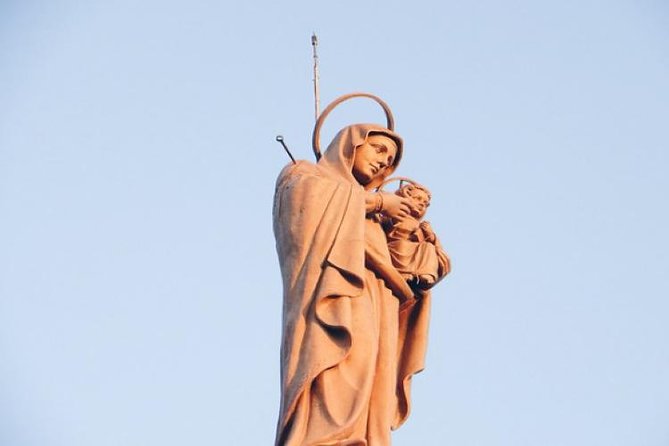
The story here is that the cave was where the Virgin Mary rested while waiting for Jesus. A young shepherd discovered the shrine on September 8, 1721. The complex includes a sacred cave, cathedral, cemetery, and a tower topped by a statue of the Virgin and Child.
The stop lasts about 15 minutes and admission is free. That makes it a brief look rather than a full religious visit, but the setting adds a different layer to the day. After the commercial energy of Sidon, Maghdoucheh offers a quieter pause and a glimpse of Lebanon’s Christian heritage.
Dress and behave respectfully at the shrine. The tour data does not specify a formal dress code, but this is an active religious site, not only a historical monument.
Tyre, the Phoenician port linked to Carthage
Tyre, known locally as Sour, is the largest historical destination on the route. Its foundations date to about 2750 BC, and the city grew under rulers such as King Hiram. Tyre was famous for purple dye made from murex sea snails, a luxury product that helped give the port international importance.
Its story includes Phoenician, Egyptian, Assyrian, Neo-Babylonian, Greek, Seleucid, Roman, Byzantine, Arab, Crusader, Mamluk, and Ottoman rule. You do not need to memorize that list, but it explains why Tyre can feel like several cities layered together.
The city is also linked to Elissar, the Phoenician princess associated with the founding of Carthage. Its seaside setting gives the modern town a more relaxed feel than Sidon, and the beaches are noted for their cleanliness.
You have about an hour in Tyre before spending another hour at the Al-Bass archaeological site. A local guide in Tyre is included, which is especially useful because the ruins cover a broad area and need explanation to make sense.
Al-Bass, Tyre’s Roman road and enormous hippodrome
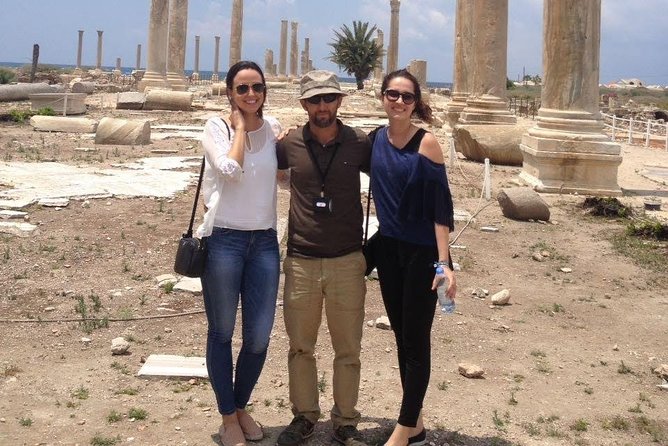
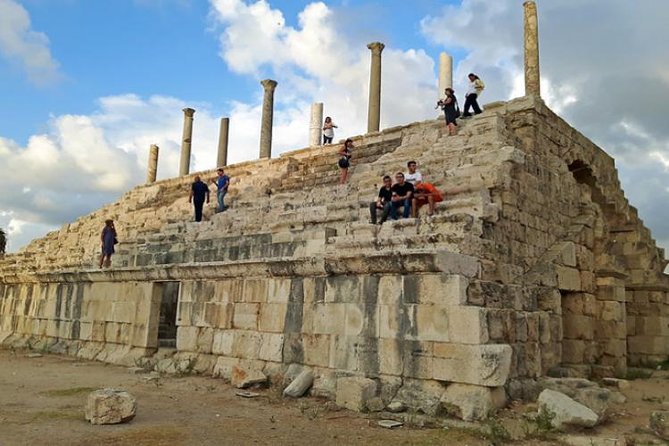
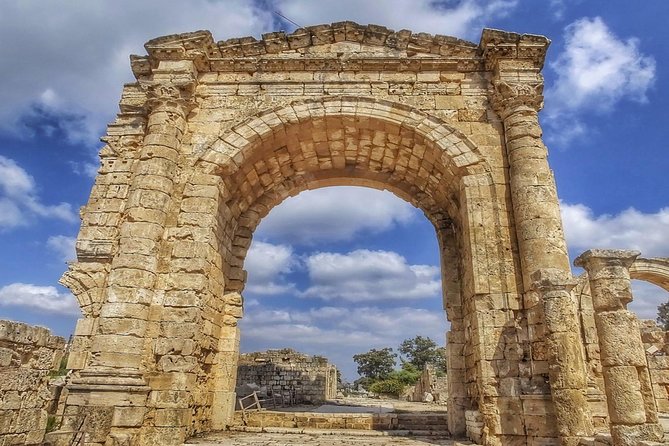
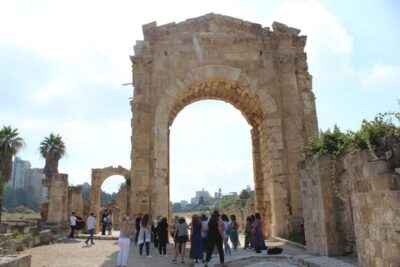
Al-Bass is the archaeological high point of the trip. The site contains a necropolis with hundreds of well-preserved sarcophagi, a Roman road, an aqueduct, and a monumental triumphal arch dating from the 2nd century AD.
The Roman hippodrome is the star. It is described as one of the largest in the Roman world and one of the best-preserved examples. Its scale helps you understand how public entertainment worked in an ancient city. This is not a small ruin that you can absorb in five minutes.
The site also marks the old entrance to Tyre. The monumental causeway, arch, burial area, and water system show the city as an organized urban center, not merely a famous port.
Admission is not included. Wear comfortable shoes and expect to walk across an open archaeological area. The provided information does not specify shade or seating, so you should be prepared for sun and a fairly active hour.
A good guide makes a real difference here. Hassan’s archaeological background, when he is assigned, would be particularly useful for explaining why the road, tombs, aqueduct, and hippodrome belong to different parts of the city’s ancient life.
Tyre’s Old Souk and the final stop
The Old Souk’s Heritage Square gives you a short look at modern Tyre. Small shops sell gold, copper, vegetables, fish, meat, clothing, and antiques. Food stalls and cafés serve items such as sandwiches, foul, and hummus.
You have about 15 minutes, so think of this as a quick orientation rather than a full meal or shopping session. Lunch is not included, and this is the logical area to discuss food with your guide if the schedule allows.
The souk makes a useful closing stop because it brings you back from monumental ruins to daily life. You see the town as a place where people shop, eat, and work, not only as an ancient site preserved for study.
What $75 includes, and where costs can grow
At $75 per person, the tour offers good value if you are traveling with enough people to make private transport worthwhile. The price covers hotel pickup and drop-off, an air-conditioned vehicle, a private driver, a tour leader, and a local guide in Tyre.
You are paying for convenience as much as sightseeing. The route covers Beirut, Sidon, Maghdoucheh, and Tyre in about nine hours. Hiring transport privately removes a major practical burden, especially if you do not want to drive between the cities yourself.
The listed price does not include lunch or admission to the Sea Castle, Soap Museum, or Al-Bass Archaeological Site. Group discounts are offered, so the value may improve for a small private group. Ask about the exact discount before booking, since no percentage is provided.
The schedule includes around four hours and 15 minutes of listed sightseeing time. The rest is used for driving, transitions, and any time needed for the day’s logistics. That is why this should be treated as a full-day outing, not a quick side trip.
Who should book this experience
I would choose this tour if you are staying in Beirut and want to see southern Lebanon without arranging separate transport. It suits couples, families, and small groups that want a private vehicle and the ability to ask questions directly.
It is also a good fit if you want variety. You will see a Crusader fortress, Ottoman-era and 17th-century commercial architecture, a craft museum, a working souk, a Christian shrine, Roman ruins, and a seaside city in one day.
You may want another option if you prefer a slow archaeological visit. The schedule is ambitious, and Tyre’s Al-Bass site alone could reward more than the allotted hour. You should also check how guiding is divided between the tour leader and local guide, since the experience is described as transport-focused rather than as a fully guided history tour from start to finish.
The tour is private, and most people can participate. Confirmation is provided when you book. Free cancellation is available if you cancel at least 24 hours before the 9:00 am start time. Changes or cancellations inside that window are not accepted for a refund.
Should you book the Sidon and Tyre tour?
Book it if you want an efficient, private day that combines major ancient sites with real city life. The strongest parts are Sidon’s Soap Museum and souks, the Sea Castle setting, and Tyre’s Al-Bass ruins, especially if you receive a guide with the enthusiasm and archaeological background associated with Hassan.
Before booking, budget for lunch and three admission charges, and accept that the day will move at a steady pace. For $75 per person, the package is most appealing when you value private transport, hotel pickup, and a varied route more than long independent stays at each site.
FAQ
How long does the tour last?
The tour lasts approximately 9 hours and starts at 9:00 am.
Does the tour include hotel pickup and drop-off?
Yes. Hotel pickup and drop-off are included.
Is the tour private?
Yes. Only your group participates in the private tour or activity.
What transportation is provided?
The tour provides comfortable private transportation in an air-conditioned vehicle with a private driver.
Is a guide included?
Yes. A tour leader and a local guide in Tyre are included. Guides who have led this experience include Hassan and Georgette.
Are admission tickets included?
No. Admission to the Crusaders Sea Castle, the Soap Museum, and the Al-Bass Archaeological Site is not included. Sidon, Khan al-Franj, the Sidon souks, Maghdoucheh, Tyre, and the Old Souk stops are listed as free admission.
Is lunch included?
No. Lunch is not included in the tour price.
Can I cancel for a full refund?
Yes, if you cancel at least 24 hours before the experience starts. Cancellations or changes made less than 24 hours before the start time are not accepted for a refund.
Just added around Beirut
- Journey Through Time: Half-Day Private Tour to Baalbek★ 5.0 · 3 reviews
- Small Group Tours to Jeita Grotto and Byblos with tickets★ 5.0 · 3 reviews
- Wine Tasting and Culture★ 5.0 · 3 reviews
- Small-Group Tour with Lunch to Jeita Grotto, Byblos and Harissa★ 4.5 · 3 reviews
- Traveling Spoon Lebanese Mezze Private Online Cooking Class★ 5.0 · 4 reviews
- Beirut to Qadisha Valley, Bcharri & Cedar: Daily Tours with Lunch★ 4.5 · 3 reviews
- Small-Group Tour to Sidon, Tyre and Maghdouche with Lunch and Tickets★ 4.5 · 3 reviews
- Small-Group Tour with Lunch to Baalbek, Anjar and Ksara★ 5.0 · 3 reviews
Sidon and Tyre Tours, compared.
Small-Group Adventure Tour to Sidon Tyre & Maghdouche-Day Trip
Read our review →
Sidon, Tyre & Maghdouche Day Trip – With Lunch (4G on Board)
Read our review →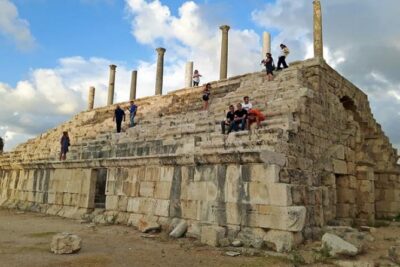
Guided Small-Group Tour to Sidon, Tyre & Maghdouche with Lunch
Read our review →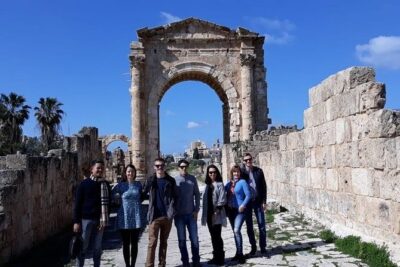
Small Group Tour to Sidon, Tyre & Maghdouche with lunch
Read our review →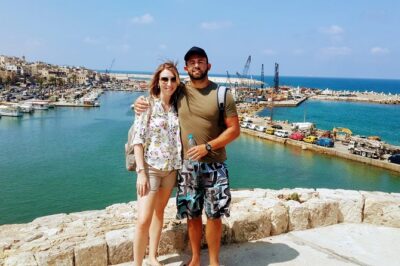
Private Guided Tour to Sidon, Tyre and Maghdouche from Beirut
Read our review →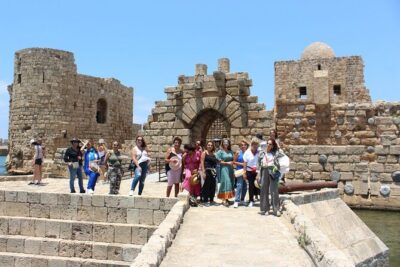
Lebanon tour Sidon & Tyre ruins with pick-up, guide,lunch+entries
Read our review →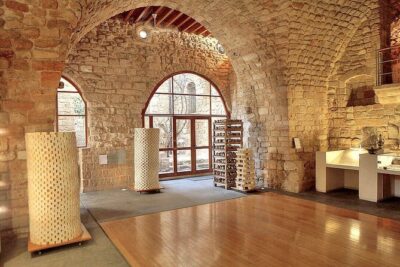
Sidon & Tyre Unesco Heritage w/pick-up, guide, entries+lunch
Read our review →Browse the lists this tour appears in