
Reviewed · FULL-DAY
Beirut Full Day Walking Tour
Beirut is easiest to understand on foot, one layer at a time. This six-hour walk moves from Roman baths and Ottoman planning to civil war scars, rebuilt districts, churches, mosques, and ordinary streets where lunch comes from a bakery. The city’s contradictions are the main attraction.
I like the small group, capped at 15, and the clear east-to-west route. I also like that the walk leaves the polished center for Zokak el-Blat, Bachoura, the antique district, and the Green Line. The main consideration is physical effort: you walk for most of the day, and the tour asks for a strong fitness level.
The guide is a major part of the experience. Several bookings specifically praise George, or Georges, for explaining politics and history with humor, honesty, and care. The tour has a 4.9 rating from 14 reviews, with 93 percent recommending it, though conditions in Beirut can change quickly and some central areas may be closed.
Key points to know before you book
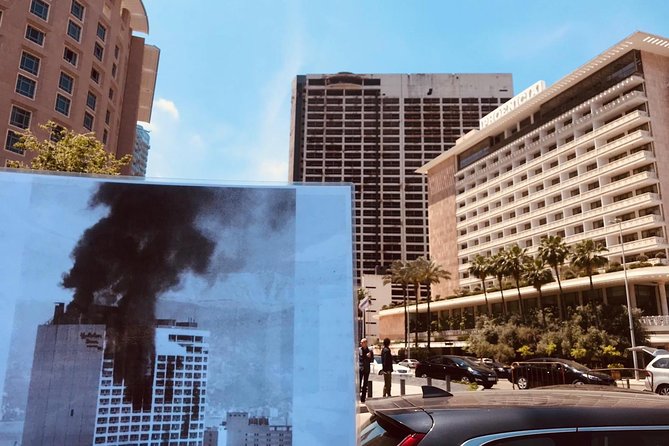
- Civil war sites are treated as part of the city, not as an afterthought: The Holiday Inn, the Green Line, and the former Metropole Cinema help explain Beirut’s recent past.
- You get more than the postcard center: Zokak el-Blat, Bachoura, Khadak el-Ghamik Street, and the antique district add local texture.
- Lunch is built into the walk: Choose lahmadjun from Ishkhanian Bakery or falafel, with coffee and beer included.
- The route connects several faiths and eras: Greek Orthodox, Maronite, and Muslim landmarks appear within a compact central area.
- George is often the guide named in the feedback: His strength is making complex politics understandable without turning the walk into a lecture.
- Plan for six hours on foot: Wear practical shoes, check the weather, and remember that gluten-intolerant diners have no street-food option.
Why this Beirut walk works
Many city tours point you toward monuments and leave the harder questions untouched. This one uses Beirut’s streets as a record of conflict, rebuilding, political power, religion, architecture, and daily life.
You begin at Martyr’s Square and eventually return there after passing through Gemmayzeh Street. That loop gives the day a useful shape. You see the grand center, move through areas with fewer formal sights, then return through streets that show how Beirut keeps being rebuilt and reinterpreted.
The guide’s role matters here. George is described as a geophysicist with archaeological training who later became a guide. That background helps explain why the walk links physical remains with the stories around them. He is also praised for being funny, direct, and reflective, which is useful in a city where political history can quickly become complicated.
Do not expect a quiet museum tour. The route crosses working streets, public squares, commercial areas, and neighborhoods with uneven rhythms. That is the point, but it also means the experience can feel intense. You are not simply looking at Beirut. You are learning how to read it.
A few more Beirut trips to weigh up
- PRIVATE Beirut Historical Walking Half Day Tour
★ 5.0 · 27 reviews - Beirut: Private Walking Tour With A Guide (Private tour)
★ 4.9 · 9 reviews
Martyr’s Square and the politics of the center
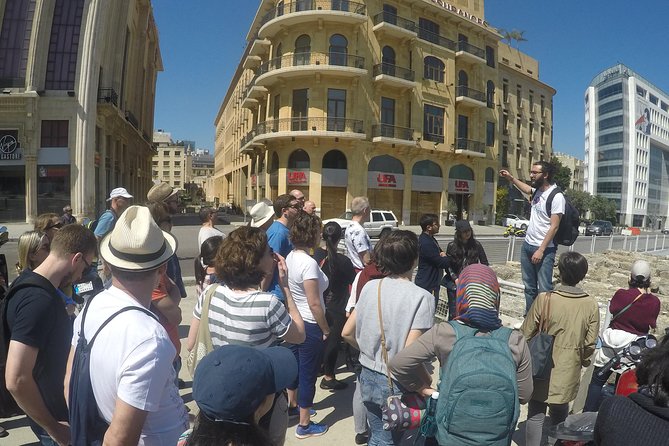
At Martyr’s Square, the opening 15 minutes introduce the statue, the remains of Le Petit Serail, and the former Ciné Opéra. This is a good starting point because the square has symbolic weight, yet the surviving pieces are not presented as a neat historic scene.
The remains of Le Petit Serail point to earlier government buildings, while the square itself leads naturally into Beirut’s modern political story. Your guide sets up the idea that central Beirut has been repeatedly planned, damaged, cleared, and rebuilt.
The next stop is Samir Kassir Square, named for the journalist and political writer assassinated in 2005. The statue provides an entry into the civil war and the political assassinations that followed it. This section is short, but the subject is serious. You will get useful context before reaching places where the war is visible in concrete and bullet-marked façades.
At Place de l’Étoile, the guide explains Lebanon’s political system, Ottoman and French urban planning, the Al Abed Clock Tower, and the Parliament. The square has a formal design that can seem detached from the surrounding disorder. That contrast is worth noticing. The layout reflects outside planning and state power, while modern Beirut often feels improvised around it.
Churches, mosques, and archaeological Beirut
The Greek Orthodox Cathedral of Saint George gets only about five minutes, so this is an exterior introduction rather than a full church visit. The short stop still matters because Beirut’s religious identity is not confined to one district or one tradition.
The Garden of Forgiveness Archaeological Area brings several layers together. From here, you can see the Mohammad al-Amin Mosque and the Maronite Saint George Cathedral, while the archaeological remains point to much older settlement. The close placement of major religious buildings makes this one of the most effective visual stops on the route.
At the Roman Baths, the guide spends about 10 minutes discussing the bath complex, the Grand Serail, and the Ottoman military hospital. The remains are not enormous, so you will get more from the explanation than from the ruins alone. Look for the way the site sits among government buildings and modern traffic. Beirut does not put its ancient past behind glass. It leaves it in the middle of the city.
This is one reason a guide adds real value. Alone, you might see stones and columns. With context, you can connect the Roman bath to later Ottoman and modern state structures within the same few blocks.
Beirut Souks, Zaytouna Bay, and rebuilt Beirut
The Beirut Souks stop lasts around 10 minutes and includes the L’Orient building and a Zaha Hadid building. This section shows Beirut’s postwar commercial ambitions and its taste for dramatic modern design.
It is also a place to ask hard questions about rebuilding. A polished shopping district can bring back investment and activity, but it may not feel like the old city that existed before reconstruction. The tour does not present redevelopment as a simple success story.
Zaytouna Bay shifts the mood. You stop by the Beirut Yacht Club for about 10 minutes, seeing a waterfront designed for leisure and private spending. The bay offers a different face of the city from the damaged buildings and crowded back streets.
I like this change of scale. In a single morning, you move from Roman remains to luxury development, then back toward religious and war-related landmarks. The route makes clear that Beirut is not one city with one identity. It is several competing versions of itself.
Same mountains and coast, a completely different kind of day:
- Guided Small-Group Tour to Baalbek, Anjar and Ksara with Lunch
★ 5.0 · 511 reviews - Guided Small-Group Tour to Jeita, Harissa, Byblos with Lunch
★ 5.0 · 361 reviews - Paragliding Trip Over Lebanon – Jounieh Bay
★ 5.0 · 257 reviews - Jeita Grotto,Harissa&Byblos Full-Day PRIVATE-CAR Trip from Beirut
★ 5.0 · 222 reviews
Saint George Cathedral and the Holiday Inn
The Maronite Saint George Cathedral is used to explain the Saint Georges and SOLIDERE real estate battle. This is another short stop, but the subject gives the rebuilt center a human and political edge.
SOLIDERE is not discussed simply as a construction project. Your guide explains the conflict over land, ownership, and the future of central Beirut. That makes the surrounding architecture easier to judge. You can appreciate the clean streets and new buildings while still asking who benefited and what disappeared.
Then comes the old Holiday Inn, one of the most striking civil war stops. The building is tied to the Qantari front and the Battle of the Hotels in 1975. Its damaged shell remains a physical reminder of how fighting took place inside the modern city.
The Holiday Inn is valuable because it is not an abstract memorial. It is a real building, designed for guests and business, that became part of a battle line. You will spend about 15 minutes here, enough time to hear the outline of the fighting and understand why the building remains such a powerful sight.
Zokak el-Blat and lunch at Ishkhanian Bakery
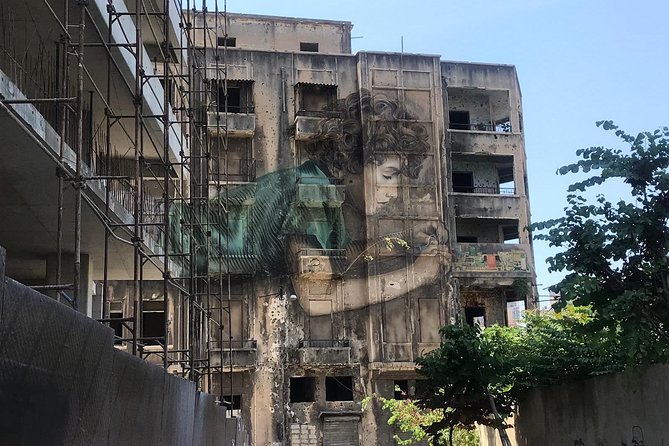
At Zekak Al Blat Public School, the route enters Zokak el-Blat, one of the less-visited parts of the day. The guide talks about 19th-century Beirut, then stops for lunch.
You get one lahmadjun from the well-known Ishkhanian Bakery, or falafel sandwiches if you prefer. Lahmadjun is a thin piece of dough topped with minced meat, and a vegetarian option is available. Coffee and beer are also included.
This is a smart lunch choice for a walking tour. You are eating something tied to local daily life, not losing an hour in a formal restaurant. It also gives you time to talk with the guide and group, which can make a small tour feel more personal.
There are limits. The food is street food, and no gluten-free street-food option is offered. If you are gluten intolerant, you should treat that as a serious planning issue rather than hoping a substitute will appear.
Zokak el-Blat also helps balance the grand center. Its streets bring you closer to older residential Beirut and the city’s ordinary scale. The school, district, food, and conversation make this one of the more grounded parts of the route.
Antique shops, Bachoura, and the Green Line
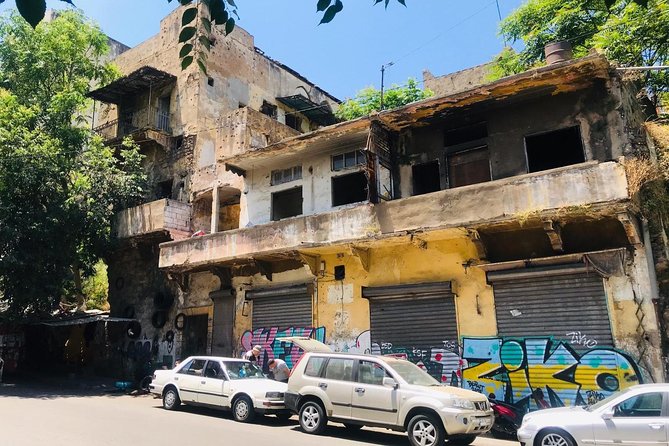
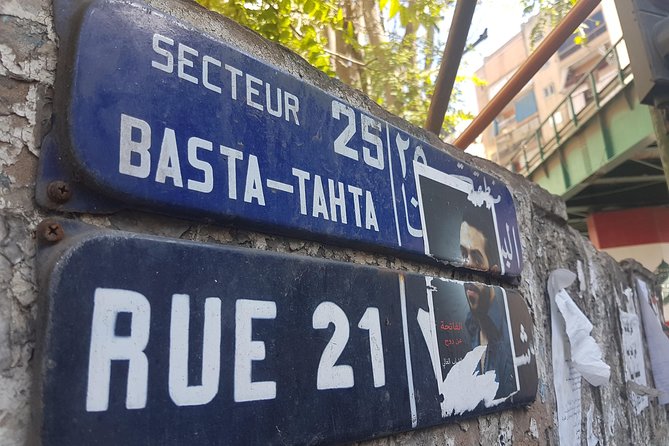
After lunch, you walk through Beirut’s antique district. The shops are expected to be closed, so this is not a shopping stop. It is a passage through the area toward Khadak el-Ghamik Street.
That detail is worth noting. If you want browsing time or open galleries, this tour will not provide it. The value is in seeing the district’s streets and hearing how the area fits into Beirut’s urban story.
The route then passes the BDD before reaching the Green Line, the separation line between Christians and Muslims during the civil war. This is one of the most important parts of the walk. The Green Line was not just a political idea. It cut through streets, neighborhoods, families, and routines.
The experience can be emotionally heavy here. The guide’s direct approach is useful because the subject needs more than a quick date and a few battle names. You get an explanation of what the division meant and how it shaped the city.
At the Egg, or former Metropole Cinema, the group stops for about 20 minutes. The cinema was transformed into a bunker during the civil war. You do not go inside, but the building itself is memorable, and the guide explains the stages of the conflict.
The Egg is a particularly good stop for understanding how ordinary urban buildings were repurposed during war. A cinema meant for entertainment became a defensive structure. You can see the physical form, but the guide supplies the human meaning.
Mohammad al-Amin Mosque and Saifi Village
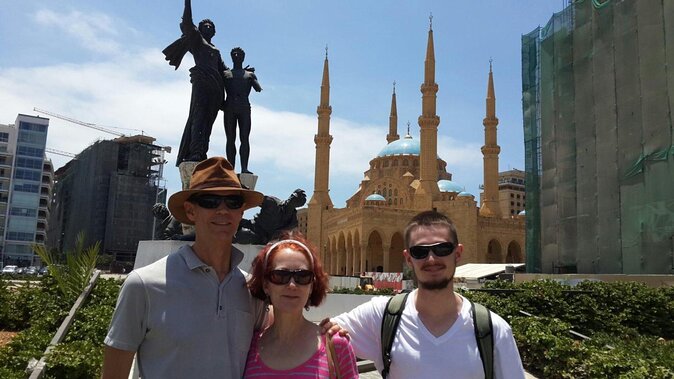
The Mohammad al-Amin Mosque is described as Beirut’s largest mosque. The visit lasts around 15 minutes and includes discussion of the assassination of former prime minister Rafic Hariri.
The mosque’s scale and location make it a major landmark, but the political context gives the stop its weight. The guide connects the building to a defining event in modern Lebanon rather than treating it as a decorative photo stop.
From there, you pass through Saifi Village, a SOLIDERE project. The guide discusses Beirut’s architectural styles, giving you another chance to compare restored or rebuilt streets with older parts of the city.
This is a good point in the day to think about style and memory. Some districts aim for a carefully polished image. Others retain visible damage or a more irregular street pattern. Neither tells the whole story alone.
Sursock, Gemmayzeh, and the walk back
The route reaches the Nicolas Sursock Museum, though the visit is brief. The guide discusses the old statue of the Martyrs and the Sursock family rather than taking you inside for a museum tour.
Do not book this walk expecting interior visits at every landmark. Several stops are short explanations from the street. That keeps the route moving and allows the tour to cover far more ground, but it means you should plan separate museum time if the Sursock collection is a priority.
The final stretch follows Gemmayzeh Street and Gouraud Street back to Martyr’s Square. Gemmayzeh gives the ending a more social and street-level feel after the formal squares, religious buildings, and war sites.
You finish where you began, after roughly six hours. The route covers a lot, and the steady pace is part of its strength. It gives you a usable mental map of central Beirut, including districts you might not choose on your own.
Price, group size, and practical value
At $41.03 per person, this is good value if you want history, politics, food, and orientation in one outing. Guiding, taxes, and lunch are included, along with lahmadjun or falafel, coffee, and beer. You still pay for personal extras, and no private transport is included.
The maximum group size is 15. That is small enough for questions and street-level conversation, while keeping the price far below a private tour. In some cases, the group may be much smaller. One booking became a solo walk after cancellations connected to unrest the night before.
The meeting point is Martyr’s Square at 9:30 a.m., and the walk returns there. The tour is near public transport, but you should arrange your own way to and from the start. A mobile ticket is provided.
Wear supportive shoes and prepare for six hours of walking. The tour requires a strong fitness level, and bad weather can lead to a new date or a full refund. The booking itself is non-refundable and cannot be changed for personal reasons, so check your plans carefully before paying.
Who should book this experience?
I would choose this tour early in a Beirut stay if you want the city explained before exploring alone. It suits you if you care about recent politics, urban change, archaeology, architecture, and local food more than a long list of interior admissions.
It is especially useful for solo visitors, first-time visitors, and anyone who finds Beirut’s street names and city layout confusing. George is repeatedly praised for clear communication, humor, and a thoughtful treatment of difficult subjects. If he is your guide, expect a strong personal voice rather than a neutral script.
You may want a different activity if you dislike long walks, need a gluten-free lunch, want extensive time inside museums and churches, or prefer a tour focused only on ancient ruins. This is a broad city walk, not a relaxed sightseeing loop.
Should you book the Beirut Full Day Walking Tour?
Book it if you want Beirut in full conversation: Roman baths beside government buildings, churches near mosques, rebuilt souks beside war-damaged towers, and lunch in an older neighborhood. The tour’s best feature is its range, and the guide turns that range into a connected story.
Skip it if you need guaranteed access to interiors, private transport, or a flexible cancellation policy. For most fit visitors who want a candid introduction to Beirut, $41.03 buys a long, substantial day and a far better sense of the city than a quick drive past its landmarks.
FAQ
Where does the Beirut walking tour start?
The tour starts at Martyr’s Square in Beirut at 9:30 a.m.
Where does the tour end?
The walk ends back at the meeting point at Martyr’s Square.
How long does the tour last?
The experience lasts approximately six hours.
How large is the group?
The group can include a maximum of 15 people.
Is lunch included?
Yes. Lunch includes one lahmadjun from Ishkhanian Bakery or falafel sandwiches, plus coffee and beer.
Is there a gluten-free street-food option?
No street-food option is provided for gluten-intolerant participants.
What happens if the weather is poor?
The activity requires good weather. If it is canceled because of poor weather, you are offered another date or a full refund.
Just added around Beirut
- Journey Through Time: Half-Day Private Tour to Baalbek★ 5.0 · 3 reviews
- Small Group Tours to Jeita Grotto and Byblos with tickets★ 5.0 · 3 reviews
- Wine Tasting and Culture★ 5.0 · 3 reviews
- Small-Group Tour with Lunch to Jeita Grotto, Byblos and Harissa★ 4.5 · 3 reviews
- Traveling Spoon Lebanese Mezze Private Online Cooking Class★ 5.0 · 4 reviews
- Beirut to Qadisha Valley, Bcharri & Cedar: Daily Tours with Lunch★ 4.5 · 3 reviews
- Small-Group Tour to Sidon, Tyre and Maghdouche with Lunch and Tickets★ 4.5 · 3 reviews
- Small-Group Tour with Lunch to Baalbek, Anjar and Ksara★ 5.0 · 3 reviews
Full-Day, compared.
Jeita Grotto,Harissa&Byblos Full-Day PRIVATE-CAR Trip from Beirut
Read our review →
Guided Private Full Day Tour to Baalbek, Anjar and Chateau Ksara
Read our review →
Jeita Grotto, Byblos and Harissa Full-Day Tour from Beirut
Read our review →
Full-Day Private Tour to Jeita Grotto, Harissa and Byblos
Read our review →
Guided Full-Day Private Trip to Cedars, Baalbek and Chateau Ksara
Read our review →
Full-Day Private Trip to Jeita Grotto, Baalbek and Chateau Ksara
Read our review →
Full-Day Guided Tour of Northern Lebanon with Hotel Pickup
Read our review →
Guided Full-Day Private Tour to Byblos and Baalbek from Beirut
Read our review →Browse the lists this tour appears in